

Description
儀式と日常の隙間に流れる、絶え間ない音楽の源泉。スペインのプロデューサー、Diego Ocejo Muñozによるプロジェクト「Dídac」のセルフタイトル・アルバムは、伝統と変容への敬意に満ちた精神的な記録だ。
制作の舞台となったのは、ジュネーヴ民族学博物館(MEG)の地下深く。Dídacは、世界最大級の民族音楽アーカイブ「L’AIMP」に保管された、東地中海の蝋管(ろうかん)レコードや典礼聖歌のテープ、人々の生活が刻まれた古い音源の中に身を投じた。それらは単なるサンプリングの素材ではなく、彼にとって対話すべき「生きた伴侶」となり、過去の記憶を現代の響きへと繋ぎ合わせる手がかりとなった。
サウンドは、ポストモダンなアンビエントのレンズを通して地中海の伝承を捉え直したものだ。静謐なドローン、穏やかなリズム、そして電子音のテクスチャーが、アーカイブ音源の剥き出しの質感と交じり合い、一枚の緻密なタペストリーを織り成している。その反復的な神秘主義と透き通るような眼差しは、Dimitris Petsetakisや、70年代後半のPopol Vuhが手掛けた映画音楽のような、深い没入感をもたらす。
針を落とせば、博物館の地下に眠っていた古い記憶が、現代の電子音と共に静かに呼吸を始める。聖なるものと俗なるもの、労働と信仰が共存する場所。ヴァイナルの溝から溢れ出すのは、カタルーニャの険しい山脈を越え、地中海の広大な情景へと誘う精神的な地図そのものだ。
アーティスト・プロフィール
Dídac (Diego Ocejo Muñoz) 1994年マドリード生まれ。カタルーニャとカスティーリャにルーツを持つ。厳格なカトリックの家庭で育ち、教会の文化に囲まれて過ごしたが、思春期にそれらを否定し、グラフィティやスケートボード、アンダーグラウンドなアシッドやエレクトロの制作に没頭した。しかし、音楽家としてのキャリアを積む中で、再び教会の神秘主義や象徴主義、合唱の伝統に深い魅力を再発見し、自らのアイデンティティを融合させた独自のアンビエント・ミュージックへと辿り着いた。
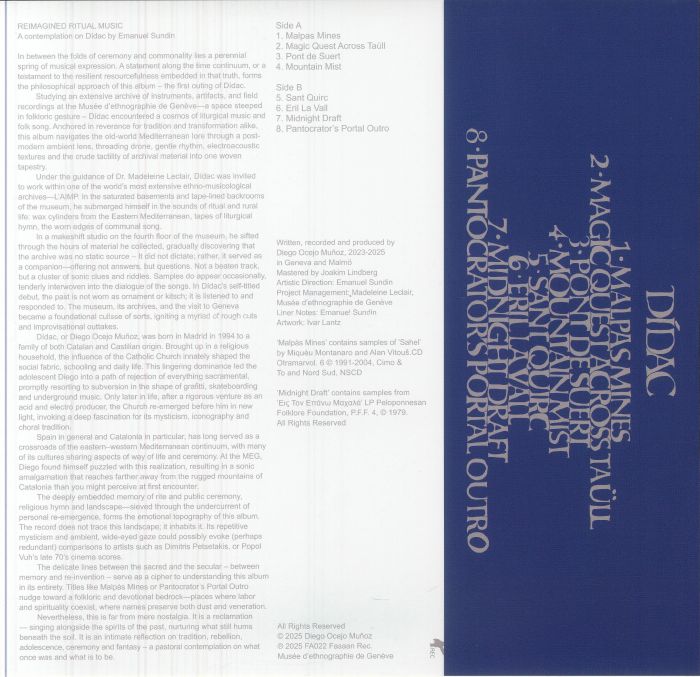
A1. Malpàs Mines
A2. Magic Quest Across Taüll
A3. Pont de Suert
A4. Mountain Mist
B1. Sant Quirc
B2. Eril La Vall
B3. Midnight Draft
B4. Pantocrator's Portal Outro
In between the folds of ceremony and commonality lies a perennial spring of musical expression.
A statement along the time continuum, or a testament to the resilient resourcefulness embedded in that truth, forms the philosophical approach of this album – the first outing of Dídac.
Studying an extensive archive of instruments, artifacts, and field recordings at the Musée d’ethnographie de Genève—a space steeped in folkloric gesture – Dídac encountered a cosmos of liturgical music and folk song. Anchored in reverance for tradition and transformation alike, this album navigates the old-world Mediterranean lore through a post-modern ambient lens, threading drone, gentle rhythm, electroacoustic textures and the crude tactility of archival material into one woven tapestry.
Under the guidance of Dr. Madeleine Leclair, Dídac was invited to work within one of the world’s most extensive ethno- musicological archives—L’AIMP. In the saturated basements and tape-lined backrooms of the museum, he submerged himself in the sounds of ritual and rural life: wax cylinders from the Eastern Mediterranean, tapes of liturgical hymn, the worn edges of communal song.
In a makeshift studio on the fourth floor of the museum, he sifted through the hours of material he collected, gradually discovering that the archive was no static source – It did not dictate; rather, it served as a companion—offering not answers, but questions. Not a beaten track, but a cluster of sonic clues and riddles. Samples do appear occasionally, tenderly interwoven into the dialogue of the songs. In Dídac’s self-titled debut, the past is not worn as ornament or kitsch; it is listened to and responded to. The museum, its archives, and the visit to Geneva became a foundational culisse of sorts, igniting a myriad of rough cuts and improvisational outtakes.
Dídac, or Diego Ocejo Muñoz, was born in Madrid in 1994 to a family of both Catalan and Castilian origin.
Brought up in a religious household, the influence of the Catholic Church innately shaped the social fabric, schooling and daily life. This lingering dominance led the adolescent Diego into a path of rejection of everything sacramental, promptly resorting to subversion in the shape of grafitti, skateboarding and underground music. Only later in life, after a rigorous venture as an acid and electro producer, the Church re-emerged before him in new light, invoking a deep fascination for its mysticism, iconography and choral tradition.
Spain in general and Catalonia in particular, has long served as a crossroads of the eastern–western Mediterranean continuum, with many of its cultures sharing aspects of way of life and ceremony. At the MEG, Diego found himself puzzled with this realization, resulting in a sonic amalgamation that reaches farther away from the rugged mountains of Catalonia than you might perceive at first encounter.
The deeply embedded memory of rite and public ceremony, religious hymn and landscape—sieved through the undercurrent of personal re-emergence, forms the emotional topography of this album. The record does not trace this landscape; it inhabits it. Its repetitive mysticism and ambient, wide-eyed gaze could possibly evoke (perhaps redundant) comparisons to artists such as Dimitris Petsetakis, or Popol Vuh’s late 70’s cinema scores.
The delicate lines between the sacred and the secular – between memory and re-invention – serve as a cipher to understanding this album in its entirety. Titles like Malpàs Mines or Pantocrator’s Portal Outro nudge toward a folkloric and devotional bedrock—places where labor and spirituality coexist, where names preserve both dust and veneration.
Nevertheless, this is far from mere nostalgia. It is a reclamation — singing alongside the spirits of the past, nurturing what still hums beneath the soil. It is an intimate reflection on tradition, rebellion, adolescence, ceremony and fantasy – a pastoral contemplation on what once was and what is to be.