
Description
アンビエント、クラウトロック、ダブが交錯する音の対話。
音の境界を解体し続けるレーベル Balmat のカタログの中でも異彩を放つ一枚。
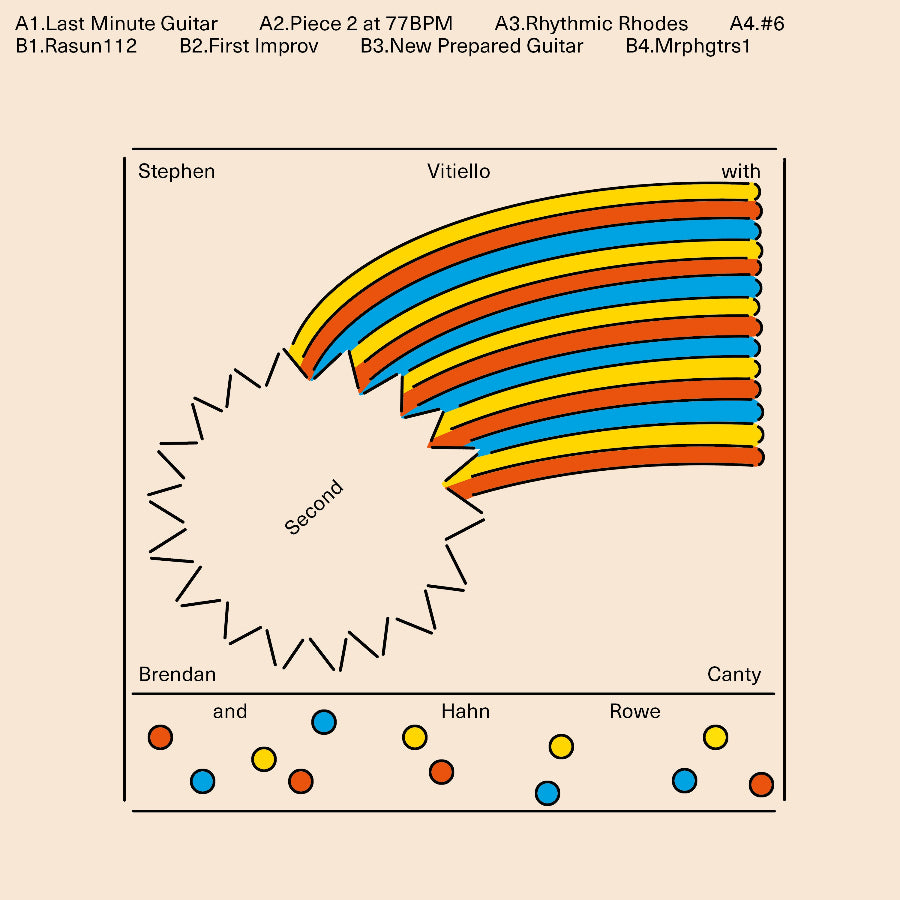
Stephen Vitiello、Brendan Canty、Hahn Rowe——それぞれ異なる音楽的背景を持つ3人が出会い、即興と構築、静寂とグルーヴ、実験と感情のあわいを縫うように生まれた作品がこの Second だ。
Vitiello はニューヨーク出身のサウンド・アーティストで、現在はヴァージニアを拠点に活動。Taylor Deupree、Steve Roden、Ryuichi Sakamoto、Nam June Paik、Pauline Oliveros といった巨匠たちとの共演で知られ、12k、Room40、Sub Rosa などから発表してきたミニマル〜アンビエント作品群で音響芸術の探求者として確固たる評価を得ている。
本作ではその繊細な音世界に、Brendan Canty(Fugazi / The Messthetics)のドラミングと、Hahn Rowe(Hugo Largo / Glenn Branca / Swans など多数)の弦と音響処理が加わり、彼自身のキャリアの中でも異例の展開を見せている。Vitiello は「サウンド・アート、アート・ロック、パンク・ロック、それぞれ違う学校の出身」と語るが、その言葉どおり、本作は3人の感性が有機的に交わる瞬間の記録だ。
アンビエント的な静けさから始まり、クラウトロック的な反復、ポストパンクの質感、そしてダブの空間処理を経て、自然発生的にグルーヴが立ち上がる。
その過程は即興性と構築性のせめぎ合いであり、まるで音そのものが呼吸を始めるようだ。特に “Mrphgtrs1” の終盤では、Animal Collective の Geologist が偶然スタジオを訪れ、ハーディ・ガーディを重ねたことで、アルバムは幻想的なドローンの中に消えていく。
レコーディングには Fugazi 時代のエネルギーと、ポストロック黎明期の余韻、そして実験音楽の繊細さが同居している。
それはジャンルを超えた「音による対話」の記録であり、まさに Balmat が求め続ける“聴くことの自由”そのもの。
音が生まれ、交わり、また消えていく。その流れに身を委ねるだけでいい。
このヴァイナルには、即興が奇跡へと変わる瞬間が刻まれている。
A1. Last Minute Guitar
A2. Piece 2 at 77BPM
A3. Rhythmic Rhodes
A4. #6
B1. Rasun112
B2. First Improv
B3. New Prepared Guitar
B4. Mrphgtrs1
BALMAT16-A1
BALMAT16-A2
BALMAT16-A3
BALMAT16-A4
BALMAT16-B1
BALMAT16-B2
BALMAT16-B3
BALMAT16-B4
When you’re running a label, a demo occasionally comes across your desk that makes you reconsider everything you thought your label was all about. For Balmat, such was the case with this stunning album from Stephen Vitiello, Brendan Canty, and Hahn Rowe. It sounds like nothing we’ve released so far—and that very otherness opened up a whole new world of possibilities for us.
Fans of ambient, experimental electronic music, and sound art will be familiar with Vitiello, a New York native, long based in Virginia, who has collaborated with a cross-generational list of greats: Taylor Deupree, Steve Roden, Lawrence English, Tetsu Inoue, Nam June Paik, Ryuichi Sakamoto, Pauline Oliveros, and many more. On labels like 12k, Room40, and Sub Rosa, he has explored a wide range of minimalism, microsound, lowercase, ambient, improv, and other styles. But this album is something different. It may begin in ambient-adjacent territory, but it quickly veers off, and it just keeps zigzagging, taking on elements of krautrock, post-punk, dub, and the groove-heavy interplay of groups like Natural Information Society and 75 Dollar Bill.
This stylistic turn is thanks in large part to Vitiello’s choice of collaborators. “We’re coming from three different schools,” Vitiello says: “sound art, art rock, and punk rock.”
Active since the early 1980s, Rowe—a violinist, guitarist, and producer/engineer—has played with, or manned the boards for, a frankly jaw-dropping list of musicians: Herbie Hancock, Gil Scott-Heron, the Last Poets, Roy Ayers, John Zorn, Glenn Branca, Swans, Live Skull, Brian Eno, David Byrne, Anohni, R.E.M., Yoko Ono, and many more. But he might be most closely associated with Hugo Largo, a one-of-a-kind New York quartet—two basses, vocals, and Rowe’s violin—that in the late 1980s helped lay the groundwork for what would eventually become known as post-rock.
Canty, of course, is the legendary drummer of Fugazi, the visionary DC post-hardcore group, as well as Rites of Spring before them, and, currently, the Messthetics, a Dischord-signed instrumental trio with guitarist Anthony Pirog and Fugazi bassist Joe Lally.
Vitiello’s trio first collaborated on First, a 17-minute piece released on the Longform Editions label in 2023. Second picks up where the freeform drift of First left off, channeling the trio’s exploratory energies into more intentionally structured tracks and—in a real first for Balmat—some almost shockingly muscular grooves. “Sometimes my projects are more conceptually driven,” Vitiello says, “but I think this was more musically geared. I just wanted to open up the references and bring in an incredible drummer, bring in some melodies, and I’m sort of the center.” But his collaborators, he stresses, are “vastly creative in making anything I might suggest better.”
Like its predecessor, Second took shape in phases, shifting between improvisation and collage. Vitiello laid down the skeleton of the music at home, sketching out initial ideas on Rhodes keyboard and acoustic and electric guitar; he then fed the parts through samplers and his modular system, recording 10- or 20-minute jams. Once he had edited them into more structured forms, he hit the studio with Canty, who added not just drums but also bass and piano; finally, Vitiello took the results of those sessions to Rowe, who played violin, viola, electric bass, and 12-string acoustic and bowed electric guitar, and assisted in some of the final structuring and mixdown.
A few more surprises along the way: Reanimator’s Don Godwin, the studio engineer where Vitiello recorded with Canty, contributed what he calls “resonant dustpan”; and none other than Animal Collective’s Geologist, who just happened to be in the studio that day, sits in on hurdy gurdy on “Mrphgtrs1,” the album’s gorgeous, stunningly atmospheric drone closer. “I love these chance encounters,” Vitiello says. “Somebody I admire, a group I admire—that was an unexpected gift.”
An unexpected gift is a great way of describing Second as a whole: three veteran musicians venturing outside their usual zones and finding a new collaborative language together. The results can’t be neatly slotted into any given genre; they belong not to any given category, but to the spirit of conversation itself.