

説明
ブラジル北東部の伝統詩と現代ポップスの感性が溶け合う、Bruno Berleらと共に新潮流を築く若き才能。
ペルナンブーコ州の丘陵地やバイーアの海岸線を吹き抜ける風を音楽へと変えるPhylipe Nunes Araújo。彼は、Gilberto GilやDjavanら巨星を輩出したブラジル北東部(ノルデスチ)の豊かな文化を背景に、シンプルで偽りのない美しさを探求し続けている。
故郷で伝統文学「コルデル」の即興詩や街頭のフォルホー、熱狂的な祭りのリズムに触れて育った彼が、11歳でインターネットを通じて出会ったThe BeatlesやNick Drake。それらがジャズやボッサ・ノーヴァの洗練された和音と重なり合い、独自のスタイルを形作った。同じノルデスチ出身の親友であり、現代ブラジル音楽界の重要人物であるBruno BerleやBatata Boyらと共にサンパウロで録音された本作は、この才能豊かなコミュニティの創造性が結実した結晶だ。
わずか15歳で書かれたBruno Berleとのデュエット「Valise」や、神秘的なバイアォンのリズムが刻まれた「Bixin」、故郷の風景を力強く描いた「Santa Cruz」など、ナイロン弦ギター一本でポップスの可能性を広げる全10曲を収録。伝統的なリズムであるココやフレヴォ、マラカトゥを現代的な視点で再構築したサウンドは、素朴でありながら知的な響きに満ちている。ナイロン弦の繊細な震えから瑞々しいヴォーカルの息遣いまで、ノルデスチの魂を宿した現代ブラジル音楽の真髄がここにある。
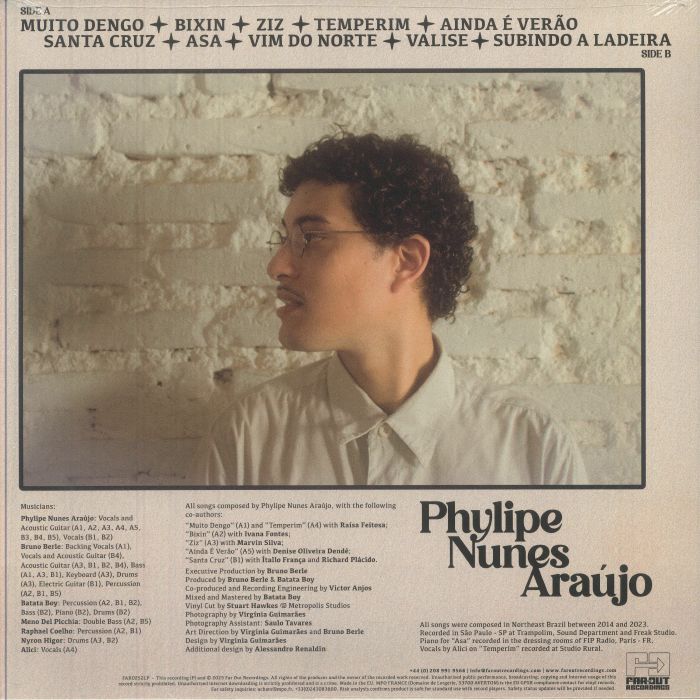
A1. Muito Dengo
A2. Bixon
A3. Ziz
A4. Temperium
A5. Ainda E Verao
B1. Santa Cruz
B2. Asa
B3. Vim Do Norte
B4. Valise
B5. Sublindo A Ladeira
Phylipe Nunes Araújo's songs are as rich and varied as the diverse landscapes they were written in. The hills of Pernambuco, the lagoons of Alagoas, and the beaches of Bahia are all woven into his stripped-back, folk-inspired Brazilian songwriting. As part of a wider movement of musicians originating from Brazil's Northeast, Phylipe sees the process of music-making as the search for beauty itself.
Collaborating with fellow Northeastern artists Bruno Berle, Batata Boy and Nyron Higor among others, Phylipe's debut album represents the latest flowering of this exceptionally talented community's creative search.
The Northeast holds an almost sacred importance in Brazil's collective cultural imagination. The region bore witness to the brutal histories of Portuguese colonization and the African slave trade, while simultaneously amalgamating the diverse cultures, religions and traditions of those who have called it home. Countless Brazilian music greats - Gilberto Gil, Caetano Veloso, Hermeto Pascoal, Djavan and Luiz Gonzaga - have emerged from this vast cultural melting pot.
Born in Caruaru, Pernambuco state, and raised in the city of Santa Cruz do Capibaribe (famed for its textiles industry), Phylipe describes his music simply as "Brazilian music from the Agreste of Pernambuco". His masterful compositions thread together regional rhythm, folk poetry and sophisticated harmony.
Phylipe's musical foundations were laid in youth, listening to the local elders rehearsing their forrós, attending São João street parties in front of his house and watching the Junina Quadrilhas dance through his neighborhood. At street fairs he would read the Literatura de Cordel (handcrafted pamphlets of Brazilian folk literature), and watch the rhyme battles between cantadores, violeiros, and repentistas, who improvise verses on daily life, social commentary and philosophy. This tradition of Northeastern folk poetry proved particularly formative for Phylipe as a lyricist. "I always try to write things as simply as possible. I believe that beauty must be easily understood. If I can facilitate the path to the message, there's no reason not to. It's something I learned from the traditional poetry here: it's more beautiful if everyone understands."
At the age of 11, Phylipe first got access to the internet. As he explains: "Still in adolescence I was also able to discover things like The Beatles and Nick Drake - I started to get to know music from the rest of the world and later to correlate that with my local musical experiences." Rich with extended chords and artful dissonances, it's clear from his compositions that jazz and bossa nova also took hold, but he's quick to eschew stereotypes. "Inevitably, people associate a Brazilian musician playing a nylon-string guitar with bossa nova..." "But the foundation is another story," he asserts, "It's the Northeast."
On the guitar Phylipe experiments with the binary rhythms inherent in traditional Northeastern music. Coco, frevo, maracatu and baião are recontextualised, placed alongside Brazilian popular music (MPB), gentle lullabies and stunning ballads. "In these 10 songs, I am experimenting with making pop music on a nylon-string guitar with my foundation in the Northeastern songbook."
The contemporary musical community which Phylipe belongs to developed initially in Pernambuco's neighbouring state Alagoas. Phylipe lived in its capital Maceió for three years, where he built friendships and musical bonds with Bruno Berle and Batata Boy who together produced his album. Bruno also sings in unison with Phylipe on the duet "Valise", a song Phylipe wrote aged just 15.
In recent years, Phylipe, Bruno and Batata have migrated south to São Paulo, where the majority of the album was recorded. Other collaborators on the album include Alici, who provides vocals for the ebb and flow of "Temperim", Nyron Higor who plays drums on lead single "Asa" and the sweet indie moment "Ziz"", bassist Meno Del Picchia who plays on the mystical baião "Bixin" and the propulsive "Subindo a Ladeira", and Raphael Coelho who joins Bruno and Batata on percussion for "Santa Cruz", Phylipe's hypnotically powerful portrait of his hometown.