
Description
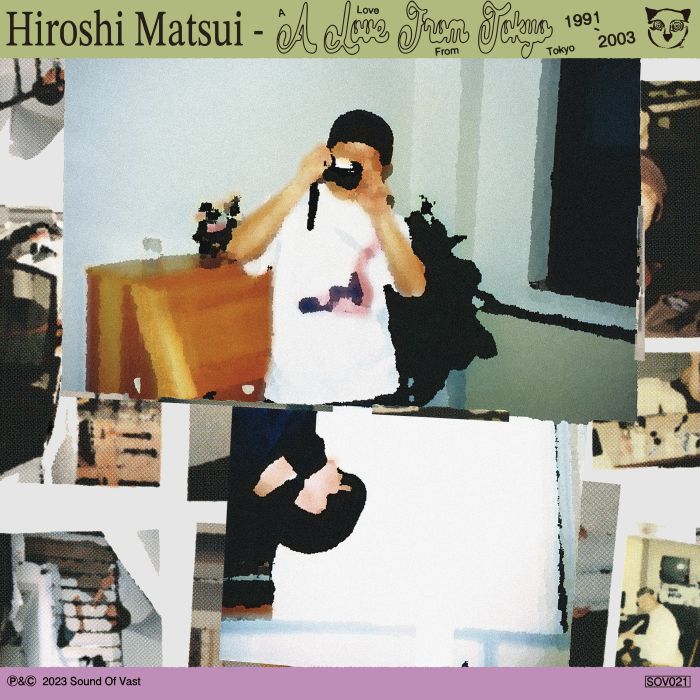
Following epoch-making reissues such as "(Earth In) Blue" (2022) from 〈Rush Hour〉 and "Samba De Howa Howa" (2019) from 〈Studio Mule〉, the album "A Love From Tokyo 1991-2003," featuring the elusive works of Japanese artist Hiroshi Matsui, is released by 〈Sound Of Vast〉.
Hiroshi Matsui is a "professional musician" who has composed and arranged numerous commercial tracks, kayōkyoku, and pop songs from 1986 to the present. The tracks included on this album are dance music that was produced and released independently on the side, alongside his work as a professional musician. Underground house fans will know that one of them, "Samba De Howa Howa," which was released in 1992 in a limited edition of 300 copies, was licensed to [King Street] and included on "Sounds Of Far East Dance Music - Compilation Vol 1" (1993) alongside Soichi Terada's "Sun Shower" and others. His releases gained cult popularity on the second-hand market due to their content and rarity. And through the aforementioned reissues and "ハウス Once Upon A Time In Japan..." (2015), supervised by Brawther & Alixkun, they were beginning to be revived on modern dancefloors.
This album compiles ten tracks produced between 1991 and 2003, including first-time reissues and previously unreleased treasures from his own 〈WANT YOU!! Records〉. The album opens with two first-time reissues: the tear-jerking piano house anthem "Crazy Love," which was included on the CD mini-album "Call You Back" released under the major Japanese label 〈Alfa Music〉 in 1991, and the breakbeat house banger "Call You Back." Here, you can immediately tell that Hiroshi Matsui's music is evergreen. "Little Bit Of Our Love" (1993), featuring Japanese vocalist Suzi Kim, who also appeared on "(Earth In) Blue" (1999), and "Super Love" (2003) are overflowing with the euphoria reminiscent of the 1990s—the first golden age of house music—while "Love Luv Rendez-vous" (1994) and "Dancing On Mars" (1994) unfold almost like subgenres of early Chicago house. The now-well-known anthem "Samba De Howa Howa" (1992) and the frantic arrangement of the jacking acid house track "Tsun-Ban-Tsun-Yeah" will surely drive even modern dancefloors into a frenzy. And the album concludes with the long-awaited previously unreleased track "Love Me One More Time" (produced in 1993).
While the tracks on "A Love From Tokyo 1991-2003" clearly reference US house music from the same period, they also showcase the melodic sense and compositional skills developed through his professional career, giving them a distinct individuality that sets them apart. They sound as if you might have heard them somewhere before, yet also completely new. In other words, this album is the source of a mysterious musical experience, as if looking back at a parallel past, and it may be within that experience that we find "love," the theme of his house music.
A1. Crazy Love
A2. Call You Back
A3. Little Bit Of Our Love
B1. Samba De Howa Howa
B2. Love Luv Rendez-vous
C1. (Earth In) Blue
C2. Dancing On Mars
C3. Tsun-Ban-Tsun-Yeah
D1. Super Love
D2. Love Me One More Time